
Experts say Maine is unusual but not unique, meaning other states could have the same key shortcoming undermining accountability and public trust.
— Read on www.usatoday.com/story/news/nation/2021/12/05/experts-call-reform-maine-attorney-general-police-shootings-justified/8835089002/
Tag: Statistics
Columbus police use force most against Black residents, study finds
Black residents were subjects of more than half of the use-of-force incidents by Columbus police from 2017 to 2019, according to Accountable Now.
— Read on www.dispatch.com/story/news/crime/2021/11/11/columbus-police-use-force-most-against-black-residents-study-finds/6373146001/
Accountable Now
Here is an interesting database for tracking police use of force.
Accountable Now collects data on police behavior from United States law enforcement agencies to share the truth about how often police use force.
— Read on www.accountablenow.com/
Desistance from Crime: Implications for Research, Policy, and Practice | National Institute of Justice
There are 6 different publications available at the website.
Why do people stop their involvement in crime? What factors help shape this process? How can policy and practice improve individuals’ chances of ending their criminal behavior?
— Read on nij.ojp.gov/desistance-from-crime
The Cost of Crime – 2
Hidden in Plain Sight: What Cost-of-Crime Research Can Tell Us About Investing in Police
Many state and local governments are facing significant fiscal challenges, forcing policymakers to confront difficult trade-offs as they consider how to allocate scarce resources across numerous worthy initiatives. To achieve their policy priorities, it will become increasingly important for policymakers to concentrate resources on programs that can clearly demonstrate that they improve their constituents’ quality of life. To identify such programs, cost/benefit analysis can be a powerful tool for objectively adjudicating the merits of particular programs.
The report can be downloaded HERE
Cost of Crime Calculator
Existing high-quality research on the costs of crime and the effectiveness of police demonstrates that public investment in police can generate substantial social returns. A Center on Quality Policing study, Hidden in Plain Sight: What Cost-of-Crime Research Can Tell Us About Investing in Police, shows how this research can be used to better understand the returns on investments in police.
Go to this website (HERE) to try the “cost of crime calculator” and see how altering police staffing affects crime in the community
The Cost of Crime
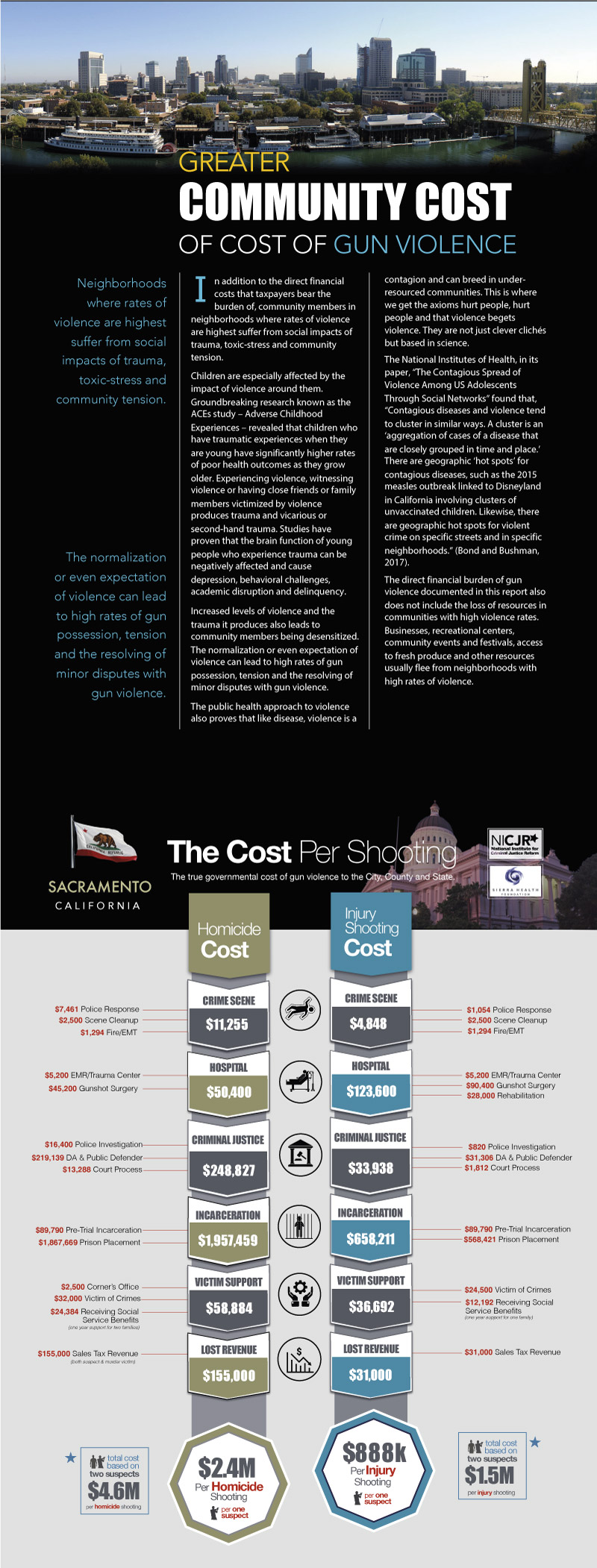
THE TRUE COST OF GUN VIOLENCE
The National Institute for Criminal Justice Reform has conducted a series of studies on the cost of gun violence in cities across the U.S., releasing findings from these studies in powerful, detailed infographic reports. These reports break down the specific governmental costs associated with each gun homicide and injury shooting, including crime scene response, hospital and rehabilitation, criminal justice, incarceration, victim support, and lost tax revenue. Following their release, NICJR partners with local organizers and other stakeholders to incorporate Cost of Gun Violence reports in advocacy efforts demanding increased investment in gun violence reduction strategies. For many of the reports, NICJR has partnered with Live Free, a national faith-based initiative to reduce incarceration and violence.
On the website there are 17 cities that calculations were made for gun violence. All of the report can be accessed HERE
Racial Disparities in Misdemeanor Speeding Convictions | RAND
In this report, researchers use data on speeding violations in Virginia to examine whether there are racial disparities in who benefits from the discretion of law enforcement and the courts to discount or downgrade misdemeanor violations.
— Read on www.rand.org/pubs/research_reports/RRA1317-1.html
A .pdf of the report can be accessed at the website.
Murders Spiked In 2020. How Will That Change The Politics of Crime? | FiveThirtyEight
There are several different points of view represented here.
Welcome to FiveThirtyEight’s politics chat. The transcript below has been lightly edited. sarah (Sarah Frostenson, politics editor): New data released by the FB…
— Read on fivethirtyeight.com/features/murders-spiked-in-2020-how-will-that-change-the-politics-of-crime/
Racist Policing And Inappropriate Use Of Force: Aurora Police, Fire Rescue Routinely Violate State And Federal Law, AG Finds | Colorado Public Radio
Colorado will require both agencies to overhaul rules around use of force, ketamine and hiring practices.
There is a link to the AG’s report available for download.
Firearm Availability, Homicide, and the Context of Structural Disadvantage – Daniel C. Semenza, Richard Stansfield, Trent Steidley, Ashley M. Mancik, 2021
Firearm Availability, Homicide, and the Context of Structural Disadvantage – Daniel C. Semenza, Richard Stansfield, Trent Steidley, Ashley M. Mancik, 2021
— Read on journals.sagepub.com/eprint/JYKWID5VHTBYYNRJE4HX/full
As of 9-11-2021 FREE .pdf AWESOME!
 Future of Policing