There is a .PDF or Word version of the report available on the website.
— Read on vcjc.vermont.gov/content/model-fair-and-impartial-policing-policy
See the policy HERE

All about Policing with a sprinkle of Criminal Justice – written by a Secret Contrarian
There is a .PDF or Word version of the report available on the website.
— Read on vcjc.vermont.gov/content/model-fair-and-impartial-policing-policy
See the policy HERE
The Alabama Department of Economic and Community Affairs will report the numbers to the U.S. DOJ to continue receiving grants.
— Read on alabamareflector.com/2025/07/29/alabama-justice-information-commission-to-track-deaths-in-law-enforcement-custody/
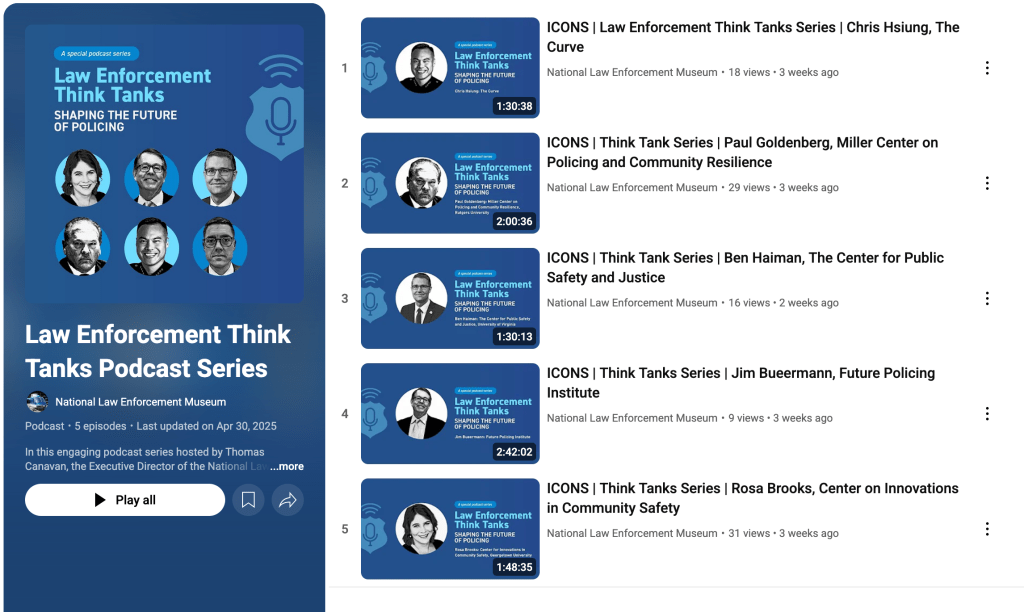
Check out this podcast series offered from the National Law Enforcement Museum. There are 5 different podcasts available. If “play all” was used the podcast will play through all the 5 different podcasts and keep the listener’s place when the podcast is stopped.
Attorney General Anthony Brown, in partnership with Public Defender Natasha Dartigue, is proud to announce the release of the Maryland Equitable Justice Collaborative’s inaugural report, “Breaking the 71%: A Path Toward Racial Equity in the Criminal Legal System.”
This comprehensive study addresses the alarming reality that Black Marylanders, while comprising only 30% of our state’s population, represent 71% of those incarcerated in our correctional facilities—the highest such disparity nationwide.
The report presents 18 evidence-based recommendations to reform law enforcement practices, criminal sentencing, health services, detention policies, reentry programs, education, and youth justice. These recommendations reflect input from state agencies, community organizations, academic institutions, and directly impacted individuals. View the full report
I call this the open science edition.
Research at the DAO
The DATA Lab at the Philadelphia District Attorney’s Office (DAO) uses police, court, and other data streams to support a wide range of research on the criminal legal system. Following are DAO DATA Lab grant-funded partnerships, DAO research publications and published and ongoing studies with research partners. We work with external partners across all phases of the research arc to help develop impactful interventions, evaluations, and scholarship. This includes discussions around data sharing, data use agreements, and facilitating research involving Assistant District Attorneys (ADAs) and DAO personnel.
— Read on data.philadao.com/Research
This was open access at the time of the posting.
The questions of when and how society should sanction juvenile offenders are subject to ongoing political and scientific debates. In this study, we use a p
— Read on link.springer.com/article/10.1007/s10940-025-09604-y
Hamilton’s Arthur Levitt Public Affairs Center has released a comprehensive report titled “Youth Gun Violence in Utica, New York: Causes, Context, and Prev
— Read on www.hamilton.edu/news/story/levitt-center-report-youth-gun-violence-utica
See the Report HERE
In this article, we examine vulnerability to gray-zone attacks and what steps can be taken to safeguard against their effects.
— Read on www.wtwco.com/en-se/insights/2025/04/blurred-lines-gray-zone-attacks-and-political-violence-coverage
A facility built for progress reflects ‘decades of neglect’ and the city’s deepest struggles, from mental illness to systemic dysfunction.
— Read on www.themarshallproject.org/2025/04/21/st-louis-justice-center-jail-reform
All about Policing with a sprinkle of Criminal Justice - written by a Secret Contrarian
News and professional developments from the world of policing
A veteran police chief committed to improving police leadership, trust, effectiveness, and officer safety.
 Future of Policing