ECHC Needs Assessment Report – Erie County NY

Final Report Issued for Erie County Holding Center and Erie County Correctional Facility Comprehensive Facility and Operational Needs Assessment

Friday, May 30, 2025
As authorized by the County Legislature, Erie County DEP commissioned a Needs Assessment of the current Erie County Holding Center and Erie County Correctional Facility. The intent was to critically evaluate the condition of each facility and associated programs, to estimate future bed space and programming needs, determine what a new state of the art, trauma informed facility would need to include, and develop preliminary cost estimates. The Consultant Team completed their report in May 2025. 
presentation was given by the Consultant Team to elected County officials and staff members on May 29, 2025.
The Final Report can be viewed here.
Visit https://erie.gov/jailstudy to view the full website.
Rethinking Electronic Monitoring: A Harm Reduction Guide | American Civil Liberties Union

Electronic monitoring was supposed to replace cash bail. If this is a failure, what’s happening to the people that are supposed to be released and monitored? Maybe placing bail on people that are a threat to society or are going to commit more crime is a good thing. Especially seeing that other methods of controlling people as they are out awaiting trial is not working. 

Rethinking Electronic Monitoring: A Harm Reduction Guide, calls on jurisdictions to replace electronic monitoring with less restrictive and more effective measures, such as court reminders and transportation assistance. The report also outlines ways jurisdictions can mitigate the harms of monitoring in accordance with due process and fairness principles.
— Read on www.aclu.org/report/rethinking-electronic-monitoring-harm-reduction-guide

The cumulative risk of jail incarceration

Research on incarceration has focused on prisons, but jail detention is far more common than imprisonment. Jails are local institutions that detain people before trial or incarcerate them for short sentences for low-level offenses. Research from the 1970s and1980s viewed jails as “managing the rabble,” a small and deeply disadvantaged segment of urban populations that struggled with problems of addiction, mental illness, and homelessness. The1990s and 2000s marked a period of mass criminalization in which new styles of policing and court processing produced large numbers of criminal cases for minor crimes, concentrated in low-income communities of color. In a period of widespread criminal justice contact for minor offenses, how common is jail incarceration for minority men, particularly in poor neighborhoods? We estimate cumulative risks of jail incarceration with an administrative data file that records all jail admissions and discharges in New York City from 2008 to 2017. Although New York has a low jail incarceration rate, we find that 26.8% of Black men and 16.2% of Latino men, in contrast to only 3% of White men, in New York have been jailed by age 38 y. We also find evidence of high rates of repeated incarceration among Black men and high incarceration risks in high-poverty neighborhoods. Despite the jail’s great reach in New York, we also find that the incarcerated population declined in the study period, producing a large reduction in the prevalence of jail incarceration for Black and Latino men.

Access the report HERE

Mass Incarceration: The Whole Pie 2020

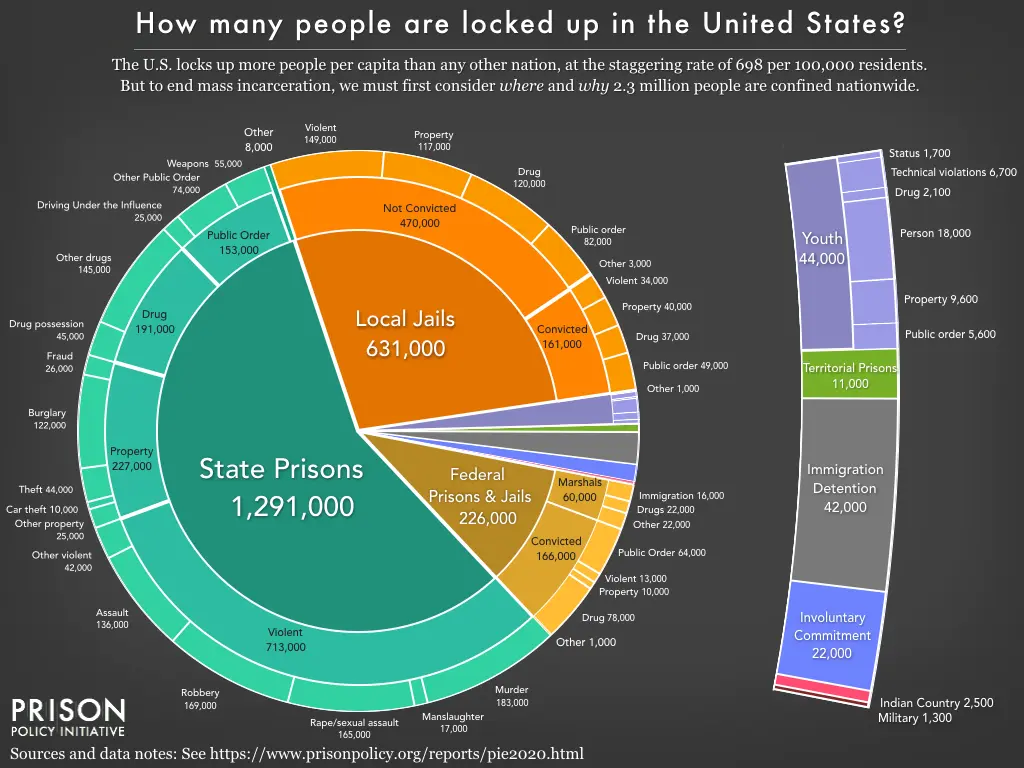
This report offers some much needed clarity by piecing together this country’s disparate systems of confinement. The American criminal justice system holds almost 2.3 million people in 1,833 state prisons, 110 federal prisons, 1,772 juvenile correctional facilities, 3,134 local jails, 218 immigration detention facilities, and 80 Indian Country jails as well as in military prisons, civil commitment centers, state psychiatric hospitals, and prisons in the U.S. territories.

This report provides a detailed look at where and why people are locked up in the U.S., and dispels some modern myths to focus attention on the real drivers of mass incarceration, including exceedingly punitive responses to even the most minor offenses.

Go to the webpage HERE

Pie chart showing the number of people locked up on a given day in the United States by facility type and the underlying offense using the newest data available in March 2020.

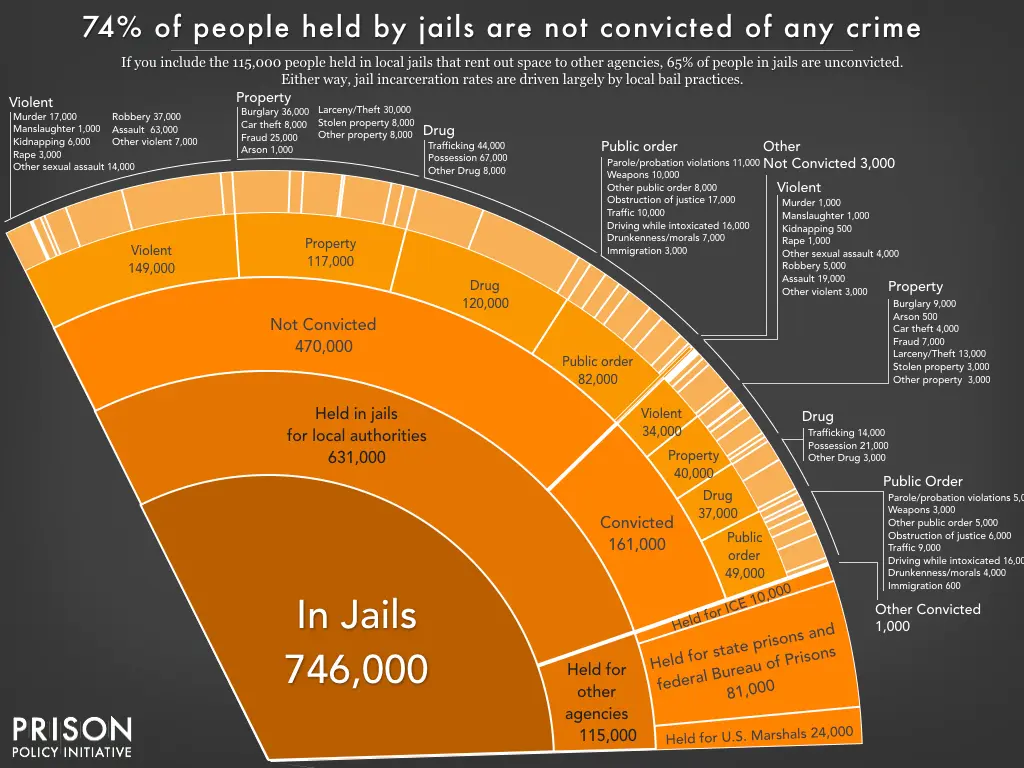
Pie chart showing the number of people locked up on a given day in the United States in jails, by convicted and not convicted status, and by the underlying offense, as well as those held in jails for other agencies, using the newest data available in March 2020.

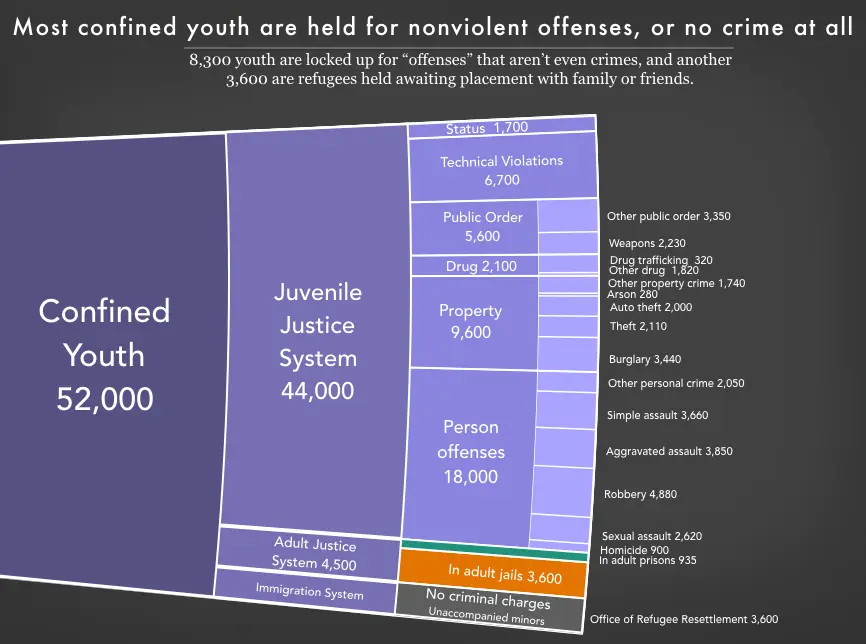
Graph showing the number of youth incarcerated in the United States by offense and whether or not they are incarcerated with adults.