
The publication can be found here: www.sentencingproject.org/wp-content/uploads/2016/01/Reducing-Racial-Disparity-in-the-Criminal-Justice-System-A-Manual-for-Practitioners-and-Policymakers.pdf
Tag: Criminal Justice System
21st Century Policing Task Force Report: The First Five Year
The National Police Foundation (NPF) partnered with the Joyce Foundation and 21CP Solutions to examine the reach and impact of the President’s Task Force on 21st Century Policing Report in the law enforcement field in the five years following the publication’s release. NPF used quantifiable measures to demonstrate diffusion of report concepts along with qualitative data on stakeholder perceptions.
In December 2014, the President’s Task Force on 21st Century Policing (hereafter “the 21CP Task Force”) was established in the aftermath of police uses of force in Ferguson, MO, Cleveland, OH, and New York City, and related First Amendment assemblies and protests across the United States. The 21CP Task Force focused policing practices that promote effective crime reduction strategies and build public trust.
In May 2015, the 21CP Task Force delivered a final report (hereafter “the 21CP Task Force Report”) with 156 recommendations and action items to law enforcement agencies and the federal government. These were organized within six pillars—building trust and legitimacy, policy and oversight, technology and social media, community policing and crime reduction, training and education, and officer wellness and safety. NPF will assess the 21CPTask Force Report’s reach and impact within the law enforcement field in the five years following the publication release.
See the Website HERE
or the Project Publications below
21st Century Policing Task Force Report: The First Five Years (Final Report)
Desistance from Crime: Implications for Research, Policy, and Practice | National Institute of Justice
There are 6 different publications available at the website.
Why do people stop their involvement in crime? What factors help shape this process? How can policy and practice improve individuals’ chances of ending their criminal behavior?
— Read on nij.ojp.gov/desistance-from-crime
The Cost of Crime
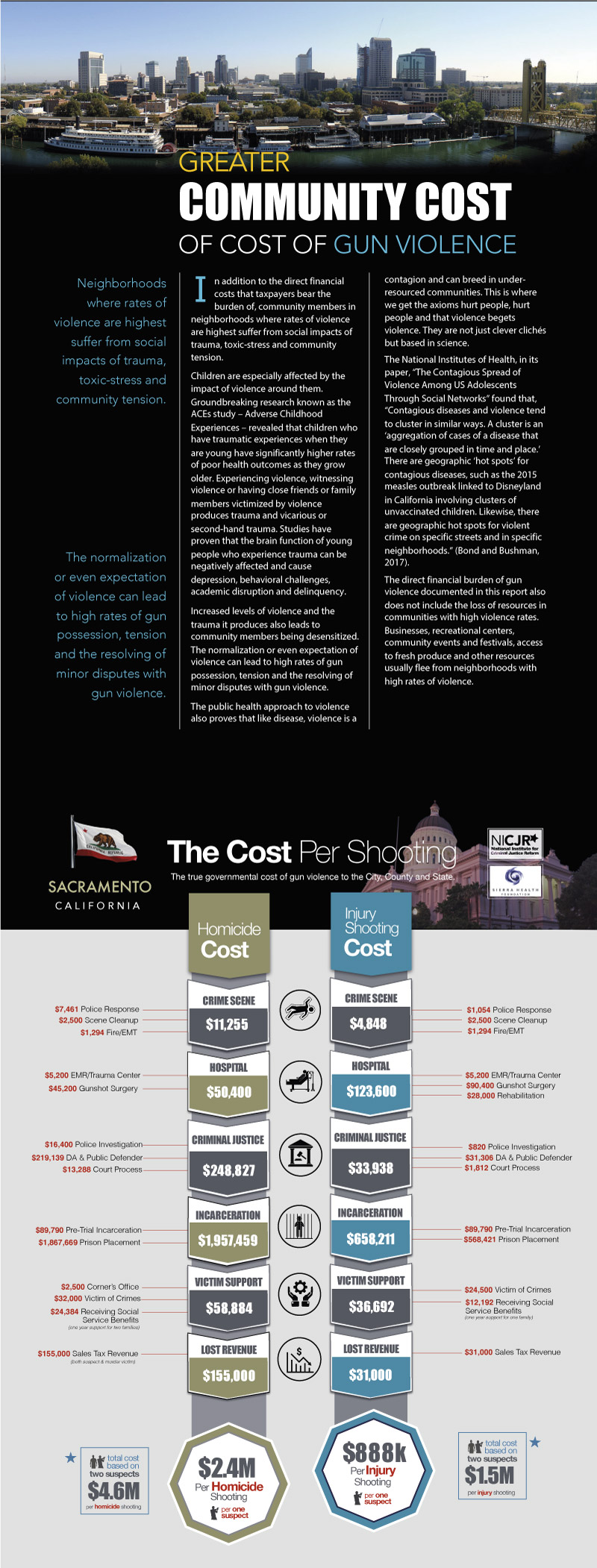
THE TRUE COST OF GUN VIOLENCE
The National Institute for Criminal Justice Reform has conducted a series of studies on the cost of gun violence in cities across the U.S., releasing findings from these studies in powerful, detailed infographic reports. These reports break down the specific governmental costs associated with each gun homicide and injury shooting, including crime scene response, hospital and rehabilitation, criminal justice, incarceration, victim support, and lost tax revenue. Following their release, NICJR partners with local organizers and other stakeholders to incorporate Cost of Gun Violence reports in advocacy efforts demanding increased investment in gun violence reduction strategies. For many of the reports, NICJR has partnered with Live Free, a national faith-based initiative to reduce incarceration and violence.
On the website there are 17 cities that calculations were made for gun violence. All of the report can be accessed HERE
Dramatically increasing incarceration is the wrong response to the recent uptick in homicides and violent crime
The question of public safety will continue to be at the forefront of our politics at the local, state, and federal level. We do not have to choose between low crime rates or low incarceration. By simultaneously pursuing both, we can make America a freer, fairer, and more peaceful nation.
— Read on www.brookings.edu/blog/the-avenue/2021/11/02/dramatically-increasing-incarceration-is-the-wrong-response-to-the-recent-uptick-in-homicides-and-violent-crime/
I hope that those who made the pendulum swing left are not denying the obvious that there are some serious factors at play causing a catastrophic increase in homicide yet the response is a kin to “nothing to see here”. A 30% increase in homicide is a cost of thousands of more lives and millions of dollars lost.
Why many Police Traffic Stops Turn Deadly
Below are a series of articles from the New York Times about how police stops turn deadly.
There are several parts to this series.
National Urban League Unveils “21 Pillars,” A Comprehensive Framework for Redefining Public Safety | National Urban League
National Urban League Unveils “21 Pillars,” A Comprehensive Framework for Redefining Public Safety | National Urban League
— Read on nul.org/news/national-urban-league-unveils-21-pillars-comprehensive-framework-redefining-public-safety
Get the toolkit HERE
Murders Spiked In 2020. How Will That Change The Politics of Crime? | FiveThirtyEight
There are several different points of view represented here.
Welcome to FiveThirtyEight’s politics chat. The transcript below has been lightly edited. sarah (Sarah Frostenson, politics editor): New data released by the FB…
— Read on fivethirtyeight.com/features/murders-spiked-in-2020-how-will-that-change-the-politics-of-crime/
The U.S. Criminal Justice System in the Pandemic Era and Beyond: Taking Stock of Efforts to Maintain Safety and Justice Through the COVID-19 Pandemic and Prepare for Future Challenges | RAND
The Priority Criminal Justice Needs Initiative convened a set of workshops with justice practitioners to take stock of responses to the coronavirus disease 2019 pandemic. They identified key challenges, system innovations, and lessons for the future.
From After-School Detention to the Detention Center: How Unconstitutional School-Disruption Laws Place Children at Risk of Prosecution for ‘Speech Crimes’ by Frank LoMonte, Ann Marie Tamburro :: SSRN
A frequently overlooked issue with school discipline is the student’s behavior. A student misbehaves in class and is noncompliant when the teacher tells the student to stop. The student isn’t protesting they are misbehaving. The teacher has no other option but to send the student to the office or call in the principal or school security. Basically at this point the student is being removed from class and if the student continues to ignore the orders of the principal or security the final ultimatum may be issued where the student is told to leave the school.
I am skipping some negotiations that also occurred like in most cases there is a history with the student. The teacher has tools to use to handle disruptive students that were employed. The prinipal and security can use de-escalation techniques however if the student resists all of these interventions then choices become limited.
Once the student is told to leave the school there noncompliance breaks the law. It sounds silly. Yeah. Why didn’t the student stop misbehaving right? If the student remains in school they can be arrested. This arrest wasn’t for a student not doing their homework, it’s not because a student was having trouble understanding the assignment, it’s not free speech. It was because the student disrupted class and would not stop. Keep in mind that there were 24 other students in class and hundreds in the school that were behaving.
As unrest erupts across the country over issues of police violence and race, how and when police use their authority inside schools is receiving renewed, and ov
— Read on papers.ssrn.com/sol3/papers.cfm
 Future of Policing