
Affordability and safety are tightly intertwined.
— Read on www.city-journal.org/article/crime-disorder-safety-affordability-cost-cities
Tag: Cost of Crime
Police spending linked to shorter lives for Black Americans
The article “Police spending linked to shorter lives for Black Americans” discusses a new study that argues increases police spending results in increases police killings and suicide of black males. The article can be accessed HERE and in the article there is a link to the academic article.
It is interesting that the study didn’t include violent crime as a factor in it’s analysis. It is possible that with the killing of 11,528 black males (2022 see graph below), illustrates the impact that the amount of violent crime in a community could effect deaths and suicides of Black men?
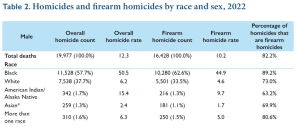
In 2022 police killed 1,201 people. Of the police killings 26% (about 312) of the killings were of black people (men and females).
My question is – In 2022 what was more dangerous to Black communities in contributing to suicide and deaths? Was it violent crime with 11,528 homicides of Black men or the police killings of 312 Black individuals? Homicide of Black men was 36.9 times greater than police killing Black persons.
Not Taking Crime Seriously: California’s Prop 47 Exacerbated Crime and Drug Abuse | Manhattan Institute
In November 2014, California voters approved a criminal justice reform measure, Proposition 47 (“Prop 47”), with almost 60% support.[1] Ten years later, California voters are now considering rolling back some of its soft-on-crime policies. Prop 47 identified six “petty” crimes—grand theft, larceny, personal drug use, forgery, and two types of check fraud—and reclassified them. It […]
— Read on manhattan.institute/article/not-taking-crime-seriously-californias-prop-47-exacerbated-crime-and-drug-abuse
The Fight Against Crime in Colorado: Policing, Legislation, and Incarceration
Additional Perspectives – How Long is Long Enough? Task Force on Long Sentences Final Report
Additional Perspectives – How Long is Long Enough? Task Force on Long Sentences Final Report
— Read on counciloncj.foleon.com/tfls/long-sentences-final-report/additional-perspectives
the Long Game — Citizens Policing Project
This is a report from a unique survey of residents that live in the affected areas of the community. It shares a different opinion that what’s in the news.
DEFUND, DIVEST, REFORM AND ABOLISH THE RESIDENT PERSPECTIVE OF THE CURRENT
DEBATE ON WHERE WE SHOULD INVEST OUR PUBLIC SAFETY DOLLARS
— Read on cpproject.org/longgame/cppreport2022
NYC Bail Trends Since 2019 : Office of the New York City Comptroller Brad Lander
Introduction The purpose of bail is to ensure that a person who is arrested returns to court for trial. However, in practice, the impact of bail has been to detain tens of thousands of New Yorkers, presumed innocent, before trial and cost low-income families tens of millions of dollars every…
— Read on comptroller.nyc.gov/reports/nyc-bail-trends-since-2019/
Evaluation of Utah’s .05 BAC Per Se Law
Is it me or do others notice too that increasing the penalty or lowering the threshold for the crime only works for a crime like Driving While Intoxicated for preventing people from driving drunk? It doesn’t work for drugs, or theft, or shoplifting but it works for DWI. Interesting. Lower the criteria for DWI thereby more people will be violating the law and it makes more people stop breaking the law. Enforce DWI laws and more people stop drinking and driving.
In the news shoplifting is rampant yet lawmakers and prosecutors want to raise the criteria for committing shoplifting and they don’t what to prosecute shoplifting after a person is arrested. Yet the argument is that shoplifting will go down?
Why does it work in just the opposite way for DWI? In most cases DWI is the same level of crime as shoplifting and they carry the same punishment for prison. DWI has powerful lobbying groups – anti-shoplifting doesn’t. DWI carries substantial state penalties in the form of thousands of dollars in fines, shoplifting doesn’t. DWI carries substantial penalties for car insurance – not shoplifting. For DWI you need an attorney, you don’t need an attorney for shoplifting especially if its your first one. Bottom line DWI costs about $9,000.00 in fines, insurance, attorney fees, shoplifting $0.00 and in some states they don’t even want to persecute shoplifting.
The crime of DWI was made more severe in an attempt to lower the number of people committing DWI and fatal crashes. The crime of shoplifting Is being treated less harshly so people stop stealing. Does this make sense?
Why don’t government treat DWI like shoplifting? Then there would probably be NO DWIs at all!!!
Results
Legislative Review. This indicated the motivation for lowering the BAC law from .08 to .05 was a desire to improve traffic safety. The majority of objections were based on hypothesized negative effects on the economy (e.g., alcohol sales, tax revenues, and tourism), the belief arrests for driving under the influence (DUI) would increase drastically for people who had “one or two drinks,” and the assumption there would be no safety benefits.
The report can be accessed HERE
The Cost of Crime – 2
Hidden in Plain Sight: What Cost-of-Crime Research Can Tell Us About Investing in Police
Many state and local governments are facing significant fiscal challenges, forcing policymakers to confront difficult trade-offs as they consider how to allocate scarce resources across numerous worthy initiatives. To achieve their policy priorities, it will become increasingly important for policymakers to concentrate resources on programs that can clearly demonstrate that they improve their constituents’ quality of life. To identify such programs, cost/benefit analysis can be a powerful tool for objectively adjudicating the merits of particular programs.
The report can be downloaded HERE
Cost of Crime Calculator
Existing high-quality research on the costs of crime and the effectiveness of police demonstrates that public investment in police can generate substantial social returns. A Center on Quality Policing study, Hidden in Plain Sight: What Cost-of-Crime Research Can Tell Us About Investing in Police, shows how this research can be used to better understand the returns on investments in police.
Go to this website (HERE) to try the “cost of crime calculator” and see how altering police staffing affects crime in the community
The Cost of Crime
THE TRUE COST OF GUN VIOLENCE
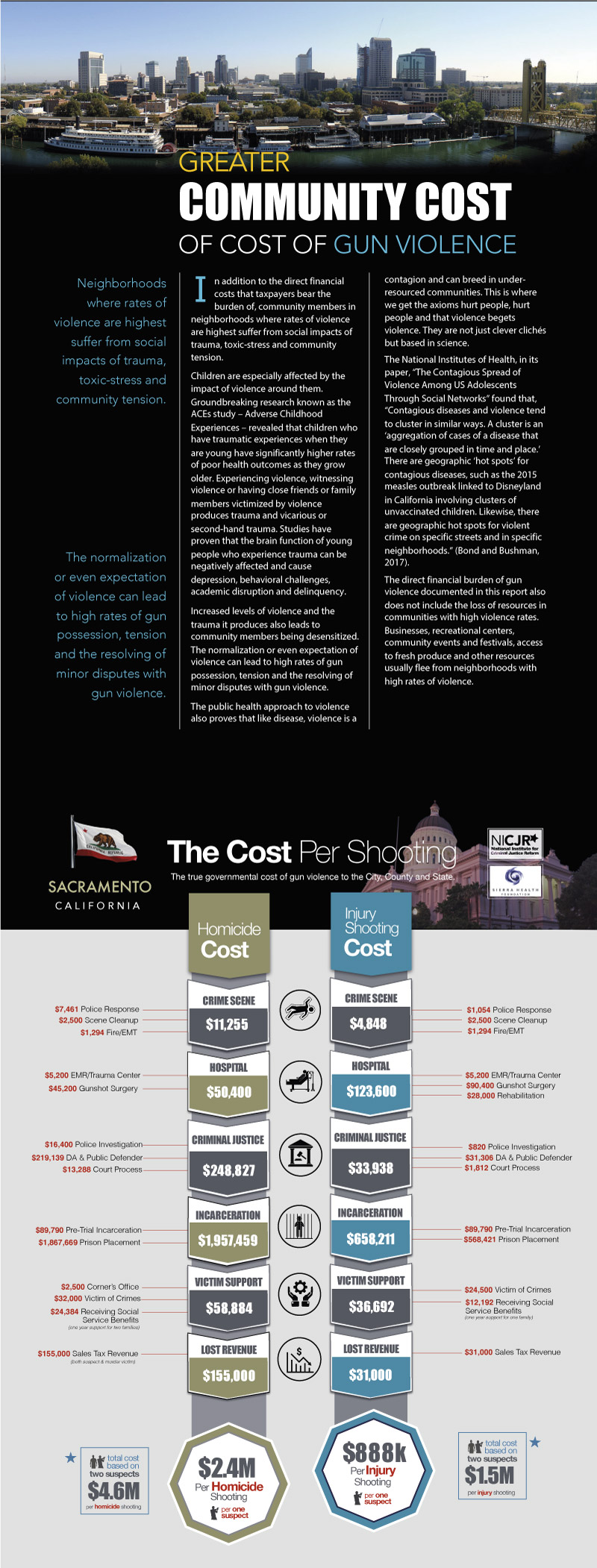
The National Institute for Criminal Justice Reform has conducted a series of studies on the cost of gun violence in cities across the U.S., releasing findings from these studies in powerful, detailed infographic reports. These reports break down the specific governmental costs associated with each gun homicide and injury shooting, including crime scene response, hospital and rehabilitation, criminal justice, incarceration, victim support, and lost tax revenue. Following their release, NICJR partners with local organizers and other stakeholders to incorporate Cost of Gun Violence reports in advocacy efforts demanding increased investment in gun violence reduction strategies. For many of the reports, NICJR has partnered with Live Free, a national faith-based initiative to reduce incarceration and violence.
On the website there are 17 cities that calculations were made for gun violence. All of the report can be accessed HERE
 Future of Policing