Pandemic, Social Unrest, and Crime in U.S. Cities: November 2020 Update

This report updates previous research by the authors with additional crime data through the end of October 2020. It examines crime rates for ten offenses in 28 American cities during the COVID-19 pandemic and social unrest over police violence. Not all cities reported data for each offense, and offense classifications varied somewhat across the cities.

See the report HERE

Building Safe, Thriving Communities Research-Based Strategies for Public Safety

Decades of harsh, carceral law enforcement practices have perpetuated cycles of violence and harm without making us safer. The number of individuals behind bars—particularly for low-level offenses—is not a measure of public safety, and in fact has tremendous costs and consequences that detract from the goal of creating healthy, stable communities. Progress toward this goal requires transformational change in the way we approach law enforcement practices, specifically in the fields of policing, prosecution, and sentencing. We cannot continue to use incarceration as our default solution. All over the country, law enforcement officials, prosecutors, and lawmakers are reducing their reliance on enforcement and incarceration, and are instead implementing practices and policies that focus on reinvestment, research-based strategies, and community engagement.

The article can be access HERE

States Can Shorten Probation and Protect Public Safety

Overview

More than 3.5 million, or 1 in 72, adults were on probation in the United States at the end of 2018—the most recent year for which U.S. Bureau of Justice Statistics (BJS) data is available—more than triple the number in 1980. Nationwide, on any given day, more people are on probation than in prisons and jails and on parole combined. At its best, probation—court-ordered correctional supervision in the community—gives people the opportunity to remain with their families, maintain employment, and access services that can reduce their likelihood of re-offending while serving their sentences. But, as previous research by The Pew Charitable Trusts has shown, the growth and size of this population have overloaded local and state agencies and stretched their resources thin, weakening their ability to provide the best return on taxpayers’ public safety investments, support rehabilitation, and ensure a measure of accountability. One key factor driving the size of the probation population is how long individuals remain on supervision.

You can get the report HERE

The Case Against Pretrial Risk Assessment Instruments–PJI 2020

Pretrial risk assessment instruments (RAIs) are actuarial tools intended to estimate two key outcomes for those who are released pending trial: the likelihood that someone will fail to appear for court, and the likelihood that someone will be arrested for a new crime before the disposition of their case. The use of RAIs is a topic of great debate among criminal justice practitioners, community advocates, formerly incarcerated people, policymakers, and academics. This paper lays out the case for why risk assessments should not be a part of pretrial decision making.

Get a copy HERE

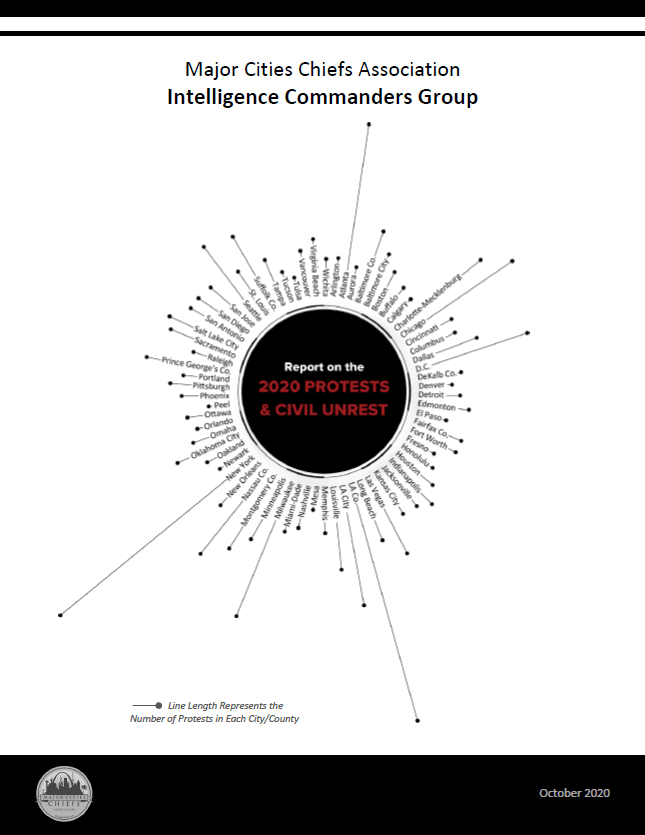
MCCA Report on the 2020 Protest and Civil Unrest

This image has an empty alt attribute; its file name is image.png
CLICK on image for link to document

Through the work of the MCCA Intelligence Commanders Group (ICG), an after-action review on this summer’s protests and civil unrest was approved for public release. From May 25th to July 31st, 8,700 total protest events occurred in 68 major cities and counties. This level of activity was unprecedented and while the majority of protests were lawful and peaceful, 79 percent of reporting agencies experienced at least one protest that involved some level of violence and in cities where violence did occur, assaults on officers, looting and arson were the most common criminal activities.

SEE Major Cities Chiefs Association (MCA) for more important resources https://www.majorcitieschiefs.com/index.php

Incoming Los Angeles District Attorney George Gascón Promises Criminal Justice Reform – KQED

Nearly 20 years ago George Gascon was the deputy chief of the Los Angeles Police Department. This month he was elected as the city’s new district attorney overcoming fierce opposition from law enforcement groups. Gascon, the former district attorney and police chief of San Francisco, campaigned on a platform of criminal justice reform, including a promise to stop prosecuting children as adults, not seeking the death penalty and possibly reopening investigations into fatal shootings by police officers. We’ll talk to Gascon about his ideas for reform and his close election, defeating LA’s first Black district attorney partly by galvanizing the support of Black Lives Matter activists.
— Read on www.kqed.org/forum/2010101880966/incoming-los-angeles-district-attorney-george-gascon-promises-criminal-justice-reform

Violent Crime Rates Declined in 10 Jurisdictions Following Comprehensive Police Reform – Center for American Progress

Violent Crime Rates Declined in 10 Jurisdictions Following Comprehensive Police Reform – Center for American Progress
— Read on www.americanprogress.org/issues/criminal-justice/news/2020/11/16/492931/violent-crime-rates-declined-10-jurisdictions-following-comprehensive-police-reform/

New York expected to legalize marijuana for recreational-use soon, Cuomo says | News, Sports, Jobs – Adirondack Daily Enterprise

Recreational marijuana must be legalized fairly in New York, dispensary owners and hemp farmers say. State officials are weighing legalizing adult-use cannab
— Read on www.adirondackdailyenterprise.com/news/local-news/2020/11/new-york-expected-to-legalize-marijuana-for-recreational-use-soon-cuomo-says/