
Abstract
This Comment explores the current state of police reform in the city of Chicago, with a special focus on the various oversight agencies currently in force. Chicago has a long history of police misconduct, and the city has tried to make changes over the years to restore the community’s trust in policing. The police reform movement became especially prevalent in recent years following the fatal shooting of Laquan McDonald by a Chicago Police Officer in 2014. This Comment will show why the current mechanisms in place are insufficient to bring the needed change to the Chicago Police Department, and that the Chicago Police Department has shown time and time again they are unable to police themselves. While there have been some effective changes to the city’s policing efforts in recent years, considerable room for improvement remains.
— Read on scholarlycommons.law.northwestern.edu/jclc/vol115/iss1/4/
Category: CRJ301 Police Mgt
Why Trump Deploying the National Guard to ICE Protests Likely Makes Matters Worse | The Marshall Project
Trump sent troops to Los Angeles after outrage over ICE raids, despite objections by California Gov. Gavin Newsom and Mayor Karen Bass — and decades of research.
— Read on www.themarshallproject.org/2025/06/09/los-angeles-ice-national-guard-protests
New Braunfels Police Staffing Study
RFK Human Rights Submits Evidence to UN Special Rapporteur of Disproportionate, Deadly Policing in the U.S. – Robert F. Kennedy Human Rights
Today, Robert F. Kennedy Human Rights (“RFK Human Rights”), submitted a detailed report to the Special Rapporteur, an independent expert appointed by the United Nations Human Rights Council, highlighting emerging trends and patterns in U.S. law enforcement’s use of lethal force.
— Read on rfkhumanrights.org/press/rfk-human-rights-submits-evidence-to-un-special-rapporteur-of-disproportionate-deadly-policing-in-the-u-s/
KUOW – SCOTUS deals setback to Seattle police officers seeking anonymity in Jan. 6 inquiry
KUOW – SCOTUS deals setback to Seattle police officers seeking anonymity in Jan. 6 inquiry
— Read on www.kuow.org/stories/scotus-deals-setback-to-seattle-police-officers-seeking-anonymity-in-stop-the-steal-inquiry
New York police officers face limited discipline for illegal searches
Questionable and illegal police searches resulted in limited discipline for many officers in New York, as the tactic fueled racial discrimination.
— Read on www.uticaod.com/story/news/state/2025/06/06/new-york-police-officers-face-limited-discipline-for-illegal-searches/84055274007/
How Is California Handling Allegations of Police Misconduct? – Public Policy Institute of California
New public data is helping to shed light on California’s current process for addressing reports of police misconduct. We take a look at what this process has yielded since its implementation two years ago.
— Read on www.ppic.org/blog/how-is-california-handling-allegations-of-police-misconduct/
Current State, Promising Practices, Needs Assessment, Recommendations
Police spending linked to shorter lives for Black Americans
The article “Police spending linked to shorter lives for Black Americans” discusses a new study that argues increases police spending results in increases police killings and suicide of black males. The article can be accessed HERE and in the article there is a link to the academic article.
It is interesting that the study didn’t include violent crime as a factor in it’s analysis. It is possible that with the killing of 11,528 black males (2022 see graph below), illustrates the impact that the amount of violent crime in a community could effect deaths and suicides of Black men?
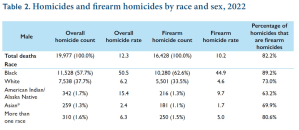
In 2022 police killed 1,201 people. Of the police killings 26% (about 312) of the killings were of black people (men and females).
My question is – In 2022 what was more dangerous to Black communities in contributing to suicide and deaths? Was it violent crime with 11,528 homicides of Black men or the police killings of 312 Black individuals? Homicide of Black men was 36.9 times greater than police killing Black persons.
Neighborhood Disorder – MOST Policy Initiative
Neighborhood disorder includes physical and social disruptions.
Disorder, also referred to as incivility, can refer to a variety of norm violating behaviors and conditions (Skogan 2015). Disorder is often categorized as physical disorder or social disorder. Social disorder refers to potentially threatening behavior from strangers while physical disorder refers to the deterioration of the urban landscape (Sampson and Raudenbush 1999).Physical disorder in neighborhoods includes (Ndjilia et al 2019):
Broken windows
Trash
Empty bottles
Deteriorated, vacant, or run-down buildings
Graffiti or vandalism
Discarded needles or drug paraphernalia
In contrast, social disorder in neighborhoods includes:Crime
Public alcohol use
Drug use or trafficking
Unwillingness to help neighbors
Prostitution
Absence of interpersonal relationships
— Read on mostpolicyinitiative.org/science-note/neighborhood-disorder/

