
Law Enforcement Data Report:
Category: CRJ101 Intro CJ
Police spending linked to shorter lives for Black Americans
The article “Police spending linked to shorter lives for Black Americans” discusses a new study that argues increases police spending results in increases police killings and suicide of black males. The article can be accessed HERE and in the article there is a link to the academic article.
It is interesting that the study didn’t include violent crime as a factor in it’s analysis. It is possible that with the killing of 11,528 black males (2022 see graph below), illustrates the impact that the amount of violent crime in a community could effect deaths and suicides of Black men?
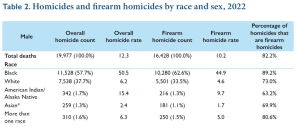
In 2022 police killed 1,201 people. Of the police killings 26% (about 312) of the killings were of black people (men and females).
My question is – In 2022 what was more dangerous to Black communities in contributing to suicide and deaths? Was it violent crime with 11,528 homicides of Black men or the police killings of 312 Black individuals? Homicide of Black men was 36.9 times greater than police killing Black persons.
Neighborhood Disorder – MOST Policy Initiative
Neighborhood disorder includes physical and social disruptions.
Disorder, also referred to as incivility, can refer to a variety of norm violating behaviors and conditions (Skogan 2015). Disorder is often categorized as physical disorder or social disorder. Social disorder refers to potentially threatening behavior from strangers while physical disorder refers to the deterioration of the urban landscape (Sampson and Raudenbush 1999).Physical disorder in neighborhoods includes (Ndjilia et al 2019):
Broken windows
Trash
Empty bottles
Deteriorated, vacant, or run-down buildings
Graffiti or vandalism
Discarded needles or drug paraphernalia
In contrast, social disorder in neighborhoods includes:Crime
Public alcohol use
Drug use or trafficking
Unwillingness to help neighbors
Prostitution
Absence of interpersonal relationships
— Read on mostpolicyinitiative.org/science-note/neighborhood-disorder/
How protests over George Floyd’s death led Colorado to rewrite its rules for policing | Aspen Public Radio
As demonstrations swirled around the Capitol five years ago, state lawmakers came together on a sweeping package of reforms that are still playing out.
— Read on www.aspenpublicradio.org/social-justice/2025-05-29/how-protests-over-george-floyds-death-led-colorado-to-rewrite-its-rules-for-policing
As Trump Abandons Police Reforms, Some Local Officials Vow to Press On | The Marshall Project
The Department of Justice said it’s pulling back from policing changes. Will cities and states have the tools to enforce them?
— Read on www.themarshallproject.org/2025/05/24/trump-police-new-york-minneapolis
Austin Police Department- Chief’s 100 day plan
It’s always an admirable endeavor for police chief come out with a plan and vision for the police department. I hope Austin Police Department is successful with its implementation. You can access the plan through the link below.
www.austintexas.gov/sites/default/files/files/Police/Chief Davis/APD-100-Day-Plan-Results.pdf
Homicide Victimization in the United States, 2023 | Bureau of Justice Statistics
Highlights
In 2023:
The rate of homicide victimization was 5.9 per 100,000 persons. This marks a decrease from the rate of 6.7 per 100,000 in 2022.
The male homicide victimization rate (9.3 per 100,000 persons) was 3.5 times greater than the homicide victimization rate for females (2.6 per 100,000).
The homicide victimization rate for black persons (21.3 per 100,000 persons) was more than 6 times the rate for white persons (3.2 per 100,000).
The largest percentage of homicide victimizations (39%) was committed by someone outside the family but known to the victim.— Read on bjs.ojp.gov/library/publications/homicide-victimization-united-states-2023
Highway Closures & Police Perspective on Riots & Lawlessness
The testimony of the Minneapolis Officers on the riots and lawlessness begins at the 1 hour 18 minute mark.
In the continuing investigation of the rioting and lawlessness following the death of George Floyd, the oversight committee reviews the highway protests and closures and hears from Minneapolis Police and Peace Officers Association.
2024 Police Violence Report
Comprehensive review of killings by police in 2024.
— Read on policeviolencereport.org/

