Mass Incarceration: The Whole Pie 2020

This report offers some much needed clarity by piecing together this country’s disparate systems of confinement. The American criminal justice system holds almost 2.3 million people in 1,833 state prisons, 110 federal prisons, 1,772 juvenile correctional facilities, 3,134 local jails, 218 immigration detention facilities, and 80 Indian Country jails as well as in military prisons, civil commitment centers, state psychiatric hospitals, and prisons in the U.S. territories.

This report provides a detailed look at where and why people are locked up in the U.S., and dispels some modern myths to focus attention on the real drivers of mass incarceration, including exceedingly punitive responses to even the most minor offenses.

Go to the webpage HERE
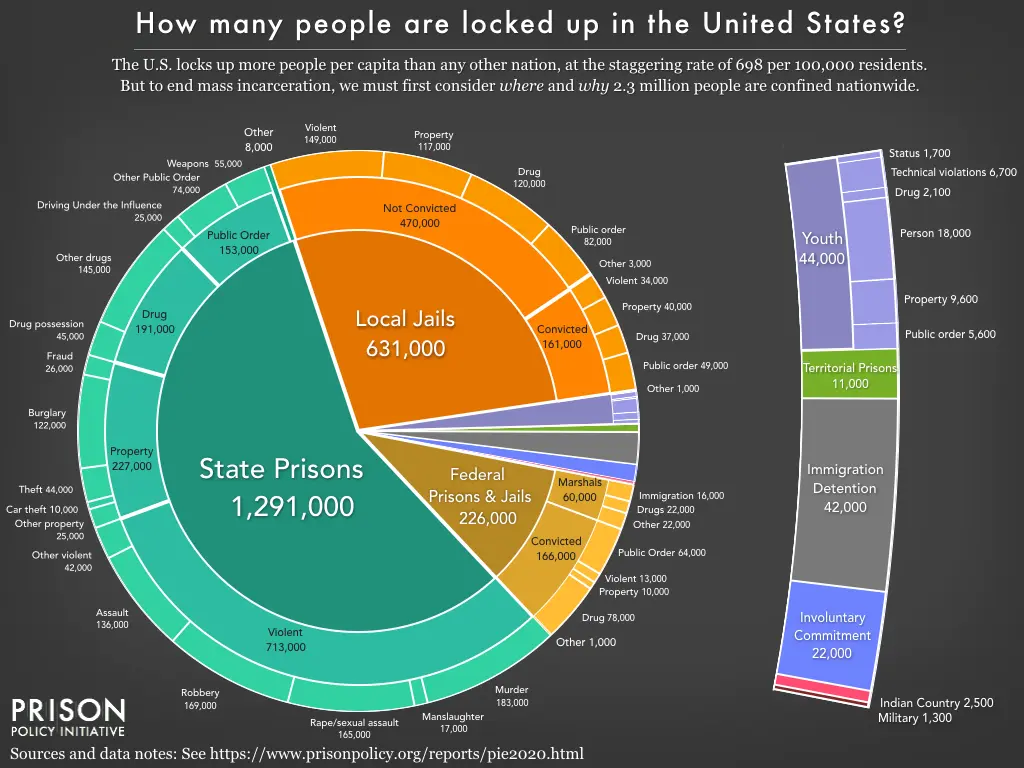
Pie chart showing the number of people locked up on a given day in the United States by facility type and the underlying offense using the newest data available in March 2020.

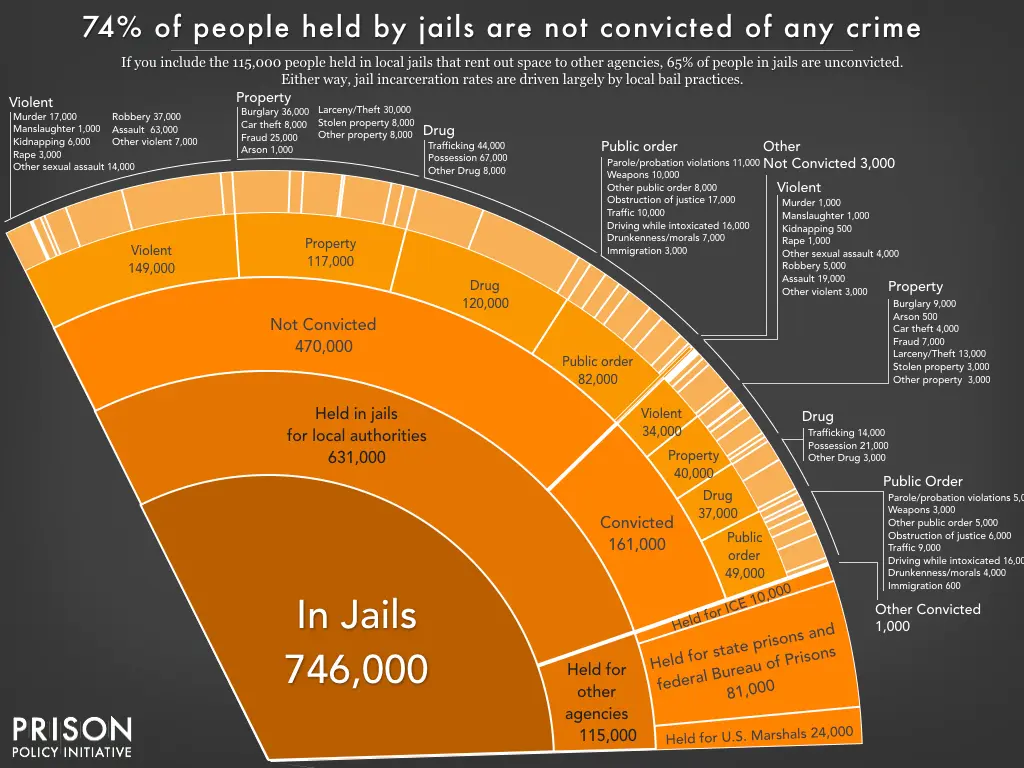
Pie chart showing the number of people locked up on a given day in the United States in jails, by convicted and not convicted status, and by the underlying offense, as well as those held in jails for other agencies, using the newest data available in March 2020.

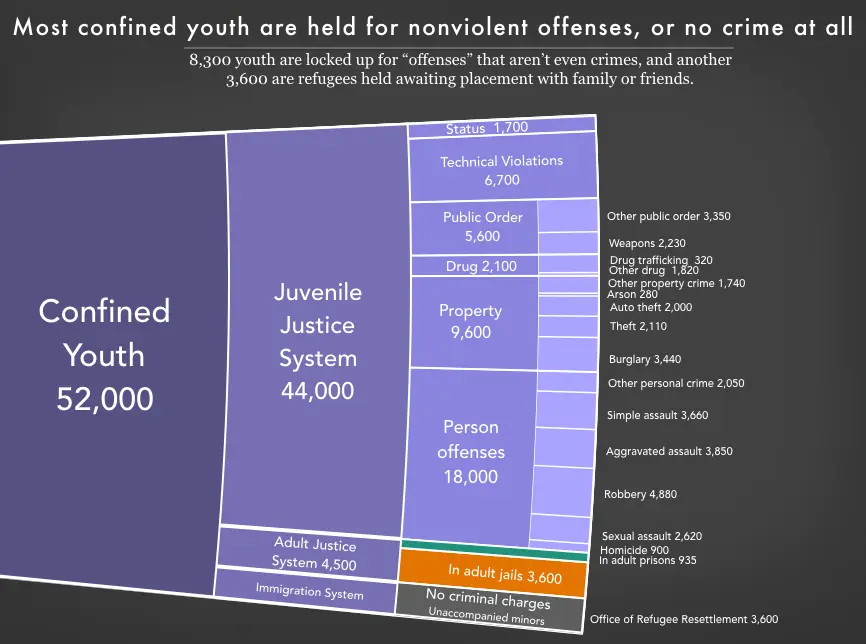
Graph showing the number of youth incarcerated in the United States by offense and whether or not they are incarcerated with adults.

RAMOS v. LOUISIANA

In 48 States and federal court, a single juror’s vote to acquit is enough to prevent a conviction. But two States, Louisiana and Oregon, have longpunished people based on 10-to-2 verdicts. In this case, petitionerEvangelisto Ramos was convicted of a serious crime in a Louisianacourt by a 10-to-2 jury verdict. Instead of the mistrial he would have received almost anywhere else, Ramos was sentenced to life without parole. He contests his conviction by a nonunanimous jury as an un-constitutional denial of the Sixth Amendment right to a jury trial. Held: The judgment is reversed.

Syllabus HERE

New York’s Latest Bail Law Changes Explained

Bail will be an option for more crimes, but the heart of the law remains intact.

New York’s new bail reform law had been in effect for a mere three months when the state legislature amended it in early April. The most significant change is that there are more situations where judges can impose cash bail. They will also have more discretion in setting bail and other conditions of pretrial release. The updates go into effect on July 1.  See  more HERE

There’s racial bias in our police systems. Here’s the overwhelming proof. – The Washington Post

This is a post from Radley Balko. Sometimes you can access the whole article sometimes you can’t it depends if you have have access to the Washington Post.

There a one key point to remember: Disproportionate is not Discrimination.

Even controlling for crime rates, class and income, racial bias infects every nook and cranny of our courts, prisons, jails and police stations.
— Read on www.washingtonpost.com/news/opinions/wp/2018/09/18/theres-overwhelming-evidence-that-the-criminal-justice-system-is-racist-heres-the-proof/

Conservatives Concerned About the Death Penalty

About Us

Conservatives Concerned About the Death Penalty is a network of political and social conservatives who question the alignment of capital punishment with conservative principles and values.

We come to this issue for a variety of reasons:

  • Some of us believe that small government and the death penalty don’t go together, especially when we compare the high costs of capital punishment to life without possibility of release.
  • Some of us don’t trust the state to get it right. We already know that some innocent people have been sentenced to death, and for others it may already be too late.
  • Some of us are disturbed by the roller coaster for family members of murder victims, or wonder why we’re investing so much in a system that doesn’t keep us any safer than the alternatives.
  • Some of us believe that the death penalty contradicts our values about protecting life.
  • And for many other reasons…