
But that could just as easily have come from President Donald Trump. Through a series of flagrantly unconstitutional executive orders, Trump has sought to silence the opposition. This culminated with an executive order demanding that the Departments of Justice and Homeland Security investigate former administration officials who pushed back against Trump’s frivolous claims that the 2020 election was stolen.
The Framers understood the danger of a despotic regime and regarded the criminal jury trial as a key procedural safeguard to help ensure that only those acts and individuals society deemed truly culpable result in criminal punishment. This is of particular importance today — in a nation plagued by rampant overcriminalization and coercive plea bargaining — where often all that stands between us and a criminal record is a prosecutor’s decision to charge.
— Read on www.cato.org/commentary/lets-empower-jurors-halt-injustice
Author: scott prell
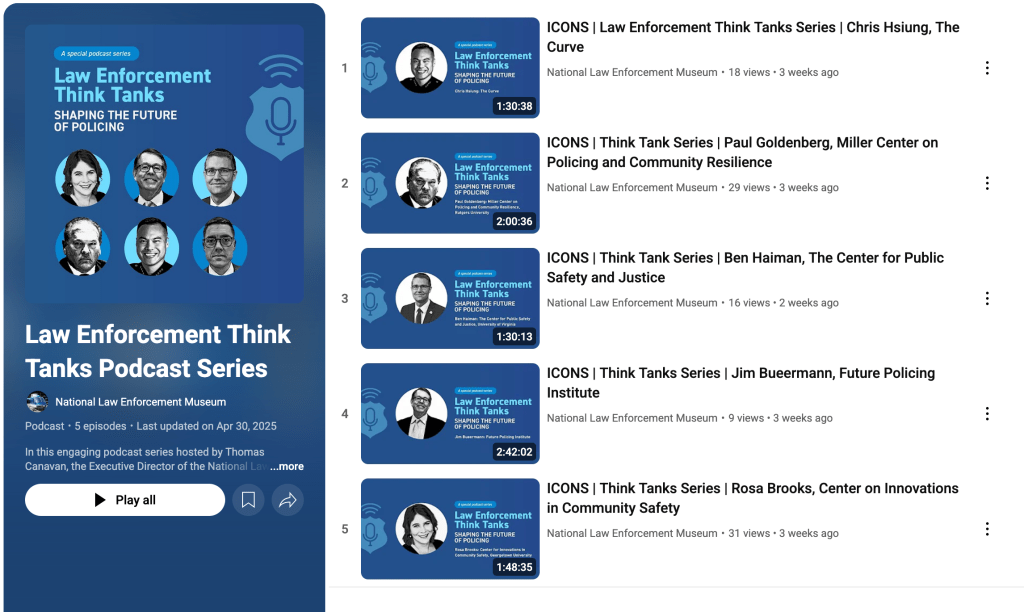
Law Enforcement Think Tanks Podcast Series
Check out this podcast series offered from the National Law Enforcement Museum. There are 5 different podcasts available. If “play all” was used the podcast will play through all the 5 different podcasts and keep the listener’s place when the podcast is stopped.
The podcasts are available HERE
We Still Need to Defund and Abolish the Police
“Defund the Police” came into the spotlight during the 2020 George Floyd uprisings. Despite what conservatives and pro-police propagandists say, “defund” never happened. But it should—because the police aren’t here to keep you safe.
— Read on www.currentaffairs.org/news/we-still-need-to-defund-and-abolish-the-police
The Supreme Court just got an important police violence case right, in Barnes v. Felix | Vox
The Birthright Citizenship argument wasn’t the only significant news out of the Supreme Court on Thursday.
— Read on www.vox.com/scotus/413340/supreme-court-police-shooting-barnes-felix
Police Reform Backlash on 5th Anniversary of George Floyd | The Marshall Project
As reforms stall in some states, the U.S. Supreme Court just made it easier for police to be sued — and perhaps easier for police to defend themselves.
— Read on www.themarshallproject.org/2025/05/17/george-floyd-police-reforms-stall
Maryland Equitable Justice Collaborative-Breaking the 71%: A Path Toward Racial Equity in the Criminal Legal System
OAG and OPD Release Groundbreaking Report on Racial Disparities in Maryland’s Criminal Legal System
Attorney General Anthony Brown, in partnership with Public Defender Natasha Dartigue, is proud to announce the release of the Maryland Equitable Justice Collaborative’s inaugural report, “Breaking the 71%: A Path Toward Racial Equity in the Criminal Legal System.”
This comprehensive study addresses the alarming reality that Black Marylanders, while comprising only 30% of our state’s population, represent 71% of those incarcerated in our correctional facilities—the highest such disparity nationwide.
The report presents 18 evidence-based recommendations to reform law enforcement practices, criminal sentencing, health services, detention policies, reentry programs, education, and youth justice. These recommendations reflect input from state agencies, community organizations, academic institutions, and directly impacted individuals. View the full report
Supreme Court analysis: Brett Kavanaugh gives a gratuitous win to cops.
The court explicitly declined to answer the big question, even though it hovered over the case and surfaced repeatedly in oral arguments.
— Read on slate.com/news-and-politics/2025/05/supreme-court-analysis-brett-kavanaugh-cop-win.html
THE FUTURE OF POLICE TRAINING IN OHIO A Blue Ribbon Task Force Report
Get the report here:
www.ohioattorneygeneral.gov/The-Future-of-Police-Training-in-Ohio
How to Sniff Out ‘Copaganda’: When the Police and the Media Manipulate Our News | Teen Vogue
Two quick notes on the comments made in this article. One is a comment about super predators. Wolfgang, a researcher, explains how 6% of a population commits the major majority of the crime. The 6% is called chronic offenders. So in some sense, there’s always existed a Super predator group in an age cohort and that’s the 6%ers that commit the most crime. The point of a super predator was that the 6% group was growing, so it was possible that there might have been more crime committed by a larger group of 6%ers.
My second comment pertains to Subway fare beating activities. Fare beaters are not poor people. Fare beaters are people who decide not to pay the subway fare because of lack of enforcement, because they know they can get away with it, or because they don’t care if they get caught because the punishment is so low. Fare beating enforcement is not an attack on people who do not have money. In fact, many people who do not have money receive subsidized cost savings on Subway fare payments. 
I wrote the book Copaganda based on my years of being a civil rights lawyer and public defender representing the most vulnerable people in our society. I watched as the police and the news media distorted how we think about our collective safety. Copaganda makes us afraid of the most powerless people, helps us ignore far greater harms committed by people with money and power, and always pushes on us the idea that our fears can be solved by more money for police, prosecution, and prisons. Based on the evidence, this idea of more investment in the punishment bureaucracy making us safer is like climate science denial.
— Read on www.teenvogue.com/story/copaganda-when-the-police-and-the-media-manipulate-our-news
Champaign’s police review board aims to improve policing, but some fear it lacks power to make change – IPM Newsroom
In 2021, shortly after she became the chair of Champaign’s civilian police review board, Alexandra Harmon-Threatt sat down to review records and video from investigations into civilian complaints that had been filed earlier that year.
In one case, a man had accused Champaign Police Officer Nicholas Krippel of being physically and verbally aggressive toward him and making physical contact without cause during a response to a verbal disagreement between a landlord and the man who filed the complaint.
“Officer Krippel got in my face, in my space,” the complainant said in an interview with Lt. Kevin Olmstead, who conducted the Champaign Police’s internal investigation. “His vest actually touched my skin, that’s how close he was to me.”
The man said Krippel had escalated the situation: “He only told me to stop talking and shut up, but he [said] nothing to the dude that threatened me.”
Harmon-Threatt’s review of Krippel’s bodycam video confirmed, in her mind, that both of these allegations had merit. But when she read Olmstead’s report, she found that it contradicted the video evidence.
— Read on ipmnewsroom.org/champaigns-police-review-board-aims-to-improve-policing-but-some-fear-it-lacks-power-to-make-change/
 Future of Policing