Taser And Social, Ethnic and Racial Disparities research programme

News report

Key findings from the research suggest:

  • There is a statistical relationship between ethnicity and increased use of Taser relative to other uses of force in some areas. This is mediated by other factors such as mental ill health, but police routine data collection needs to improve to properly understand these patterns;
  • The disproportionate use of Taser across different communities and populations stems from complex interactions between multiple factors, structures, and processes, both within and external to policing;
  • Policing takes place within a society fractured by inequality and structural racism in that Black and other ethnic minority populations are more likely than White people to live in areas of deprivation;
  • A combination of institutional priorities, policies, practices, and demands mean that policing is concentrated into areas of deprivation, which in turn disproportionately impacts on people from Black and ethnic minority backgrounds relative to the White population;
  • Given that police are more active in deprived neighbourhoods, this in turn makes Taser use in those areas more likely;
  • Taser has become institutionalised as an organisational level response to perceived threat and risk, which increases its use in situations that previously have been resolved in other ways, such as through dialogue;
  • Police officers count Taser among the least dangerous use of force options available to them, and risks associated with its use are under emphasised during training. Insufficient time is dedicated to discussions of ethnic disproportionality and de-escalation during Taser training, which risks creating a further push towards the use of the weapon;
  • In contrast, affected communities experience Taser as a dehumanising and potentially lethal weapon. They also emphasised the psychological harms and racialised traumas generated through use of the weapon;
  • Public scrutiny mechanisms designed to hold police officers to account lack adequate support.

See the report here:

www.ucl.ac.uk/security-crime-science/sites/security_crime_science/files/taserd_report_13_dec_2023.pdf

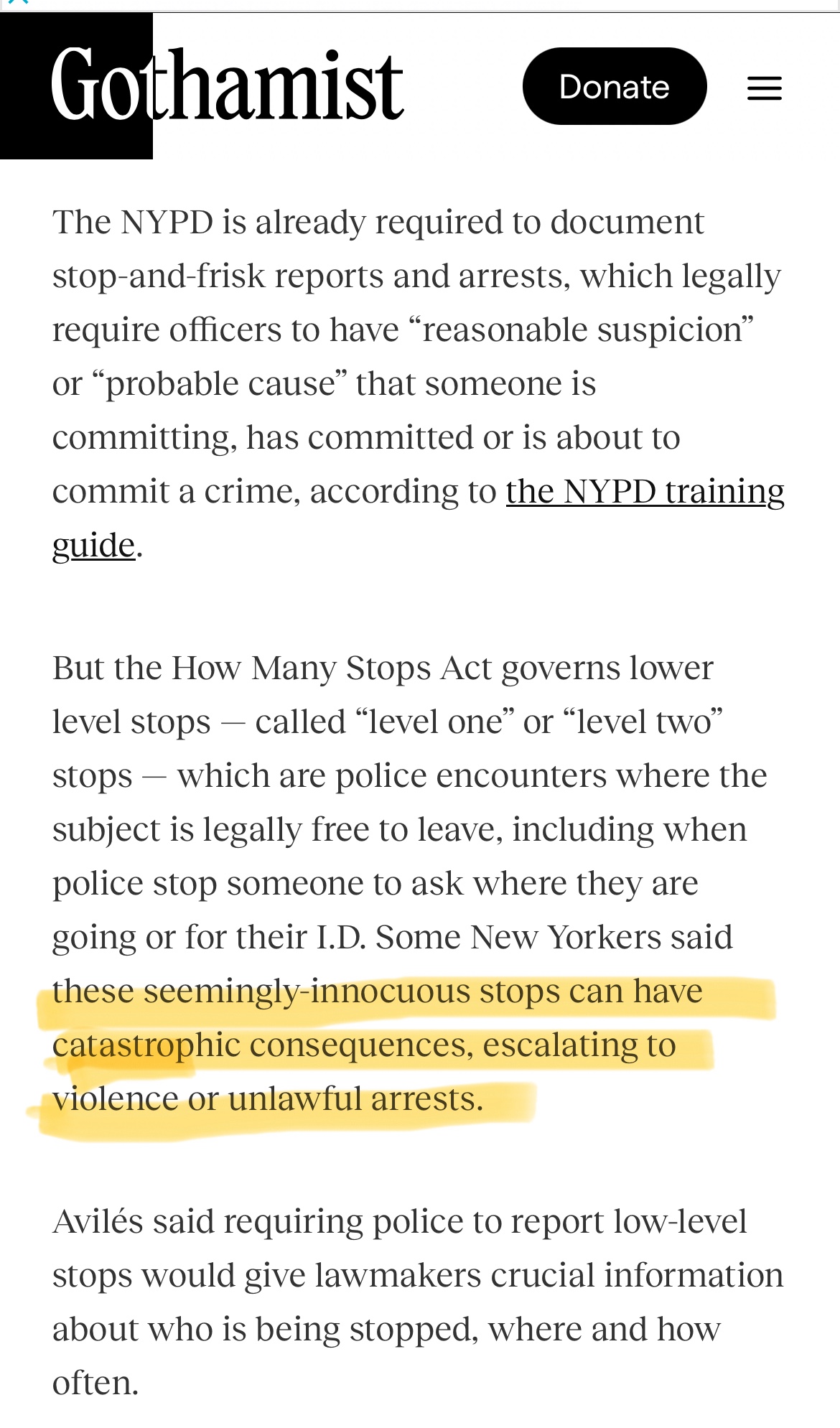
NYC lawmakers set to require NYPD to report low-level stops – Gothamist

This narrative that minor police and citizen contacts are dangerous is false and is not supported by the evidence. Do police-citizen contacts involving minor incidents sometimes end badly? Yes. But in context of 10s to 100s of millions of police-citizen contacts per year it is an extremely rare occurrence for citizens to be injured and even more rare for citizens to be killed.

If the types of police-citizen contacts are looked at starting with violent and serious crime decreasing in severity of call type to the most casual non-criminal type of police-citizen contacts breakdown in following categories:

  • 1-2% Serious and violent crime
  • 5% Felonies
  • 10% Misdemeanors
  • 25% Violations & VTL
  • 60% Non-criminal contacts

Looking at the breakdown of the of types of police calls, it is obvious that the most police-citizen contacts that occur in non-law-enforcement situations, minor crime, and low level crime situations. Therefore it makes sense that much of the police-citizen contacts that end badly fall into the noncriminal type contacts, the violation level, VTL level, and low level crime type of police activity. It should not be surprising that when police have contact with citizens even at a non-criminal level contact, there is always a potential of the contact ending badly because there are millions of such of these types of contacts and if a person starts becoming violent for some reason the police must respond accordingly.

Many of the police-citizen contacts that turn to violence are driven by the citizen. Police react to the behavior of the citizen. So, at any time, if a citizen becomes violent, the police must escalate their level of force to overcome the citizens level of force. And innocuous type call can escalate into violence when a citizen becomes violent and could end in the death of that citizen. For example, if a citizen pulls a gun on a police officer. In this type of example, the officer does not drive the situation they merely respond to the situation.

Gothamist is a non-profit local newsroom, powered by WNYC.
— Read on gothamist.com/news/nyc-lawmakers-set-to-require-nypd-to-report-low-level-stops

D.C. police distribute free AirTags for vehicles as carjackings soar – The Washington Post

Commentary: The police should take this concept a step further. There should be an software application the a police department has where the public can register a vehicle and an AirTag or similar device so if a vehicle gets stolen the victim can open an App on there phone and indicate that their car was stolen. This App would immediately notify the police and the begin the track the vehicle realtime so the police can monitor the stolen vehicle. This would allow the police to coordinate resources for a possible intervention and apprehension.

After the emergency button is pressed for the initial notification the victim can begin to answer a few questions to complete the police report process. This could also begin a deposition and other important information.

The two-day giveaway event on Tuesday and Wednesday was one of the latest efforts from city leadership to address rising carjacking in the District.
— Read on www.washingtonpost.com/dc-md-va/2023/12/06/dc-police-airtag-carjacking/

The Truth about George Floyd- The Glenn Show

The Glenn Show is an excellent podcast that at times tackles the issues of race, crime, and policing.

In this episode the authors discuss the documentary “The Fall of Minneapolis” (see earlier posts for a link). The authors are academics and not police. They have interesting discussions and opinions on the film and the George Floyd incident.

Bloggingheads.tv
— See it on bloggingheads.tv/videos/67137

Reversal of qualified immunity decision in LAPD fatal shooting

A deep dive into the 2018 case where LAPD Officer Edward Agdeppa fatally shot Albert Dorsey. Explore the subsequent federal lawsuit by Dorsey’s mother against Agdeppa for alleged unreasonable deadly force, and its implications on Fourth Amendment rights.
— Read on www.police1.com/legal/articles/ninth-circuit-reverses-course-and-issues-new-ruling-giving-lapd-officer-qualified-immunity-sntvJPP8OSuv0p1S/