
The question now is not whether George Floyd’s death changed anything—it did. The question is: Who has the power to shape what comes next?
— Read on newsone.com/6174511/five-years-after-george-floyd-lessons-for-future-movements/
Tag: Police Operations
POLICY PLATFORMS – M4BL
Black life and dignity require Black political will and power. Despite constant exploitation and perpetual oppression, Black people have bravely and brilliantly been a driving force pushing toward collective liberation. In recent years, we have taken to the streets, launched massive campaigns, and impacted elections, but our elected leaders have failed to address the legitimate demands of our Movement. We can no longer wait.
In response to the sustained and increasingly visible violence against Black communities in the U.S. and globally, a collective of more than 50 organizations representing thousands of Black people from across the country came together in 2015 with renewed energy and purpose to articulate a common vision and agenda. We are a collective that centers, and is led by and rooted in, Black communities. And we recognize our shared struggle with all oppressed people: collective liberation will be a product of all of our work.
— Read on m4bl.org/policy-platforms/
DOJ Right to Dismiss Lawsuits Against Police Departments
The move reflects the Trump administration’s rejection of the “disparate impact” theory of liability.
— Read on www.city-journal.org/article/doj-disparate-impact-theory-biden-civil-rights-law-enforcement-policing
ACLU and Community Groups Launch Campaign to Demand Justice and Transparency as Trump DOJ Abandons Federal Police Oversight | American Civil Liberties Union
Commentary: 2 key concepts about policing that are important to understand.
The first is policing is local. Police in California and New York are similar but they are also different. If a police department in California does something improper that is not an indication that the police in New York are doing the same improper act. This leads to the second point, Governmental Home Rule. This means that each municipality is it’s own government. This allows the local city, town, or village (c-t-v) to have dominion over it’s municipal agencies. This allows each local government to control it’s police department. Therefor each municipal government, if it chooses, can MANDATE police reform of it’s local police department.
The bottom line is that the DOJ is not needed to initiate police reform. The Governments in Memphis, TN, Louisville, KY, Lexington, MS, Phoenix, AZ, Minneapolis, MN, Mount Vernon, NY, and Worcester, MA, can force their local police department to initiate or continue reforms suggested from the DOJ investigations.
When police department reform is initiated at the local level it works better. The Mayor or Supervisor of a C-T-V calls for police reform, the Council or Trustees support it (at least through a budget line), the Chief or Commissioner of the police department makes the change. If the Chief/Commissioner doesn’t follow through with the reform that can be fired. If the Council or Trustees don’t support the reform efforts they can be voted out of office. The same with the Mayor or Supervisor if they don’t mandate police reform they can be voted out of office. Now the citizens have a voice, if they think reform is not needed they can use their voices and votes to make changes. The same if a large enough group is calling for reform they can pressure their local government to make changes.
This is much better that having the secret DOJ control local police reform. The C-T-V elected officials have no voice, only to agree with the DOJ’s findings. The community can’t pressure anyone because the DOJ is not elected by the community.
The ACLU Press Release
The Seven States Safety Campaign targets police departments where the Biden DOJ found rampant police brutality and racial targeting
— Read on www.aclu.org/press-releases/aclu-and-community-groups-demand-justice-and-transparency-as-trump-doj-abandons-federal-police-oversight
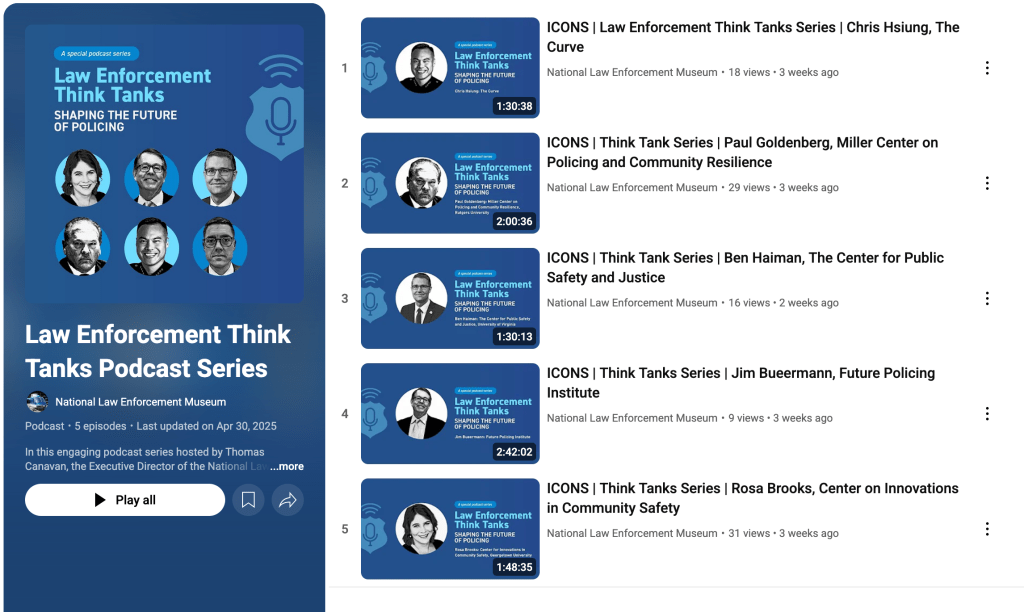
Law Enforcement Think Tanks Podcast Series
Check out this podcast series offered from the National Law Enforcement Museum. There are 5 different podcasts available. If “play all” was used the podcast will play through all the 5 different podcasts and keep the listener’s place when the podcast is stopped.
The podcasts are available HERE
We Still Need to Defund and Abolish the Police
“Defund the Police” came into the spotlight during the 2020 George Floyd uprisings. Despite what conservatives and pro-police propagandists say, “defund” never happened. But it should—because the police aren’t here to keep you safe.
— Read on www.currentaffairs.org/news/we-still-need-to-defund-and-abolish-the-police
The Supreme Court just got an important police violence case right, in Barnes v. Felix | Vox
The Birthright Citizenship argument wasn’t the only significant news out of the Supreme Court on Thursday.
— Read on www.vox.com/scotus/413340/supreme-court-police-shooting-barnes-felix
Supreme Court analysis: Brett Kavanaugh gives a gratuitous win to cops.
The court explicitly declined to answer the big question, even though it hovered over the case and surfaced repeatedly in oral arguments.
— Read on slate.com/news-and-politics/2025/05/supreme-court-analysis-brett-kavanaugh-cop-win.html
THE FUTURE OF POLICE TRAINING IN OHIO A Blue Ribbon Task Force Report
Get the report here:
www.ohioattorneygeneral.gov/The-Future-of-Police-Training-in-Ohio
How to Sniff Out ‘Copaganda’: When the Police and the Media Manipulate Our News | Teen Vogue
Two quick notes on the comments made in this article. One is a comment about super predators. Wolfgang, a researcher, explains how 6% of a population commits the major majority of the crime. The 6% is called chronic offenders. So in some sense, there’s always existed a Super predator group in an age cohort and that’s the 6%ers that commit the most crime. The point of a super predator was that the 6% group was growing, so it was possible that there might have been more crime committed by a larger group of 6%ers.
My second comment pertains to Subway fare beating activities. Fare beaters are not poor people. Fare beaters are people who decide not to pay the subway fare because of lack of enforcement, because they know they can get away with it, or because they don’t care if they get caught because the punishment is so low. Fare beating enforcement is not an attack on people who do not have money. In fact, many people who do not have money receive subsidized cost savings on Subway fare payments. 
I wrote the book Copaganda based on my years of being a civil rights lawyer and public defender representing the most vulnerable people in our society. I watched as the police and the news media distorted how we think about our collective safety. Copaganda makes us afraid of the most powerless people, helps us ignore far greater harms committed by people with money and power, and always pushes on us the idea that our fears can be solved by more money for police, prosecution, and prisons. Based on the evidence, this idea of more investment in the punishment bureaucracy making us safer is like climate science denial.
— Read on www.teenvogue.com/story/copaganda-when-the-police-and-the-media-manipulate-our-news
 Future of Policing